 |
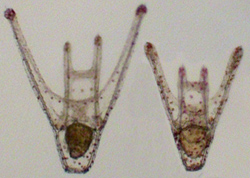
| Fig. 1. Poorly fed (left) and
well-fed (right) sibling echinopluteus larvae of the sea urchin
Lytechinus variegatus on day 4 of development. Note greater investment in ciliated
band and internal skeleton under low food conditions. Photo by
JS McAlister. |
Environmental heterogeneity creates a special
challenge for character expression, because a given phenotype may not be
optimal across all conditions. Phenotypic plasticity allows many
organisms to adaptively match trait expression to particular environments.
We have been taking advantage of a classic example of adaptive plasticity to
examine tradeoffs that govern the expression of plasticity. Echinoid
larvae allocate more to growth of feeding structures (ciliated larval
arms, and the internal skeleton that supports them) when food is scarce,
but shift allocation to developing post-larval structures when food is
plentiful. Justin McAlister, then a grad student and now a faculty
member at the
Holy
Cross, tested for possible
constraints on the evolution of this form of plasticity. In previous experiments
with the echinoid Lytechinus variegatus, he demonstrated
significant genetic variation for larval plasticity (see Fig. 1).
He then used a quantitative genetic breeding design and measures of
growth rate to test an important theoretical prediction of a cost to
plasticity: that more "plastic" genotypes, which have a fitness
advantage across environments, will experience lower fitness relative to
more "fixed" genotypes within environments.
internal skeleton that supports them) when food is scarce,
but shift allocation to developing post-larval structures when food is
plentiful. Justin McAlister, then a grad student and now a faculty
member at the
Holy
Cross, tested for possible
constraints on the evolution of this form of plasticity. In previous experiments
with the echinoid Lytechinus variegatus, he demonstrated
significant genetic variation for larval plasticity (see Fig. 1).
He then used a quantitative genetic breeding design and measures of
growth rate to test an important theoretical prediction of a cost to
plasticity: that more "plastic" genotypes, which have a fitness
advantage across environments, will experience lower fitness relative to
more "fixed" genotypes within environments.
Our work with Macrophiothrix brittlestars also provided the first
test of whether larval plasticity is expressed in ophiuroids. This question
is of special interest because the pluteus larvae of echinoids (Fig. 1) and
 |
| Fig. 2. Ophiopluteus larva of
Macrophiothrix longipeda. Armspan approx 1.7 mm. Photo
by JD Allen. |
ophiuroids (Fig. 2), although morphologically and functionally similar, appear from
phylogenetic and developmental evidence to be independently derived. We
have found that the expression of developmental plasticity in these ophiuroids
is similar in timing, persistence, and magnitude to results previously
published for echinoids. Our demonstration of plasticity in larval skeletal
growth is one of first examples where plasticity for a convergently-evolved
trait appears itself to be convergent.


